


Episode Preview
RISHI JAIN (00:00):
So, this partnership between us and 1PointFive, where we use the term “pioneering innovation” a lot. Those two terms, they stand out. We want to be in a space where things are new for us, for our colleagues, and we are in that comfortable/uncomfortable space. Because if you’re going to lead, you need to move into new territories.
Introduction
AMIL SHAH (00:28):
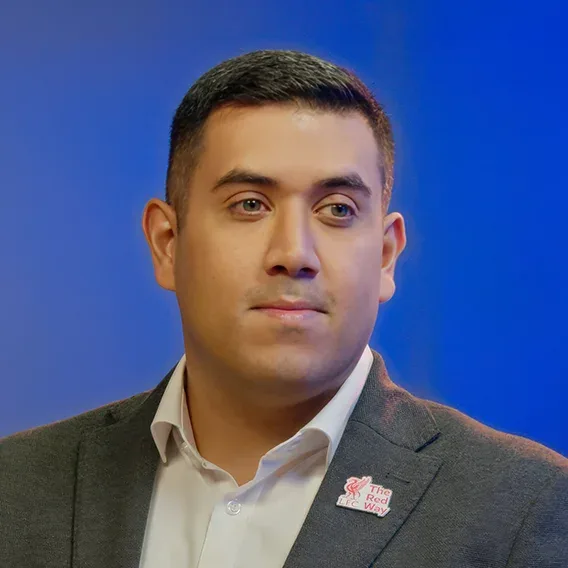
This is Speaking in Tonnes. I’m your host, Amil Shah. My guest today is Rishi Jain of Liverpool Football Club. As Director of Impact, Rishi leads the Red Way, one of sport’s most ambitious sustainability programs, and he’s helped to launch 1Nil, a first of its kind carbon removed product line. Welcome, Rishi.
RISHI JAIN (00:47):
Thank you, Amil.
The Red Way Mission
AMIL SHAH (00:48):
Can you tell us more about Liverpool Football Club’s sustainability program, the Red Way?
RISHI JAIN (00:53):
The Red Way is built of three pillars, as most ESG programs are. The top line of it is to build a better future for our people, our planet and our communities. So, our people pillar is everything around leadership, accountability, responsibility—the three words that are really, really important to us. Planet pillar is probably, and hopefully, everything that you’d like to say from an organization that’s committed to the environment.
We’ve got 2030, 2040 emissions reductions target. We’ve got a net zero target in there as well around wastewater, biodiversity, circular economy, and then the communities pillar is probably one of our most exciting areas. So, it’s a mix of the incredible work of LFC Foundation, the club’s official charity.
So, my team, we work in partnership with the foundation and ultimately we try and support them as best we can to achieve their targets: To work with 500,000 young people by 2030, which is hugely aspirational, but tells you everything about the impact of what they do. And then the other half of that is how we work with our commercial partners. So, my job is to work with our commercial team to align 100% of our commercial partners to the Red Way.
Partnering to Build a New Product Line
AMIL SHAH (01:57):
As part of the mission with the Red Way, Liverpool Football Club partnered with 1PointFive to create this 1Nil line of decarbonized products. How do you think that partnership fits into your broader objectives? Both for the Red Way and for Liverpool Football Club. And how did we come up with the decision to use the Istanbul Champions League jersey as the first product?
RISHI JAIN (02:20):
The answer the first part of that question is: How does it fit into the Red Way? It fits absolutely perfectly. We want to lead to be very honest. We want to be top of the Premier League. We want to win the Champions League. People say it might be boring, but I’d love to win both of those trophies every single year.
Personally, obviously for obvious reasons. But professionally, like, you want to be part of a winning team. The Red Way is very much a part of that, and whilst I can’t influence things on the pitch, from a business perspective, the Red Way is integral to how we operate both commercially and operationally.
So, this partnership between us and 1PointFive, where we use the term “pioneering innovation” a lot. Those two terms, they stand out. So, we want to almost be in that slightly uncomfortable space where we are pushing ourselves into the unknown. And that’s exactly what this feels like. Direct Air Capture wasn’t really a term. Well, it wasn’t a term that we focused on already knew much about.
So, it pushes into that realm. And obviously, as well as looking at emissions, that actually just moves us into that space where you can talk about something which is genuinely exciting. People obviously can see it beyond just as well in terms of the jersey itself, obviously, Istanbul.
And obviously, you know, this, I mean, there’s this iconic, the most iconic probably football match in European competition probably ever.
So, to align something so innovative and new with a huge moment in our history actually works really, really well. And obviously the jersey itself is beautiful. But then to add the technology side and the decarbonization messaging, and actually the sustainability story alongside that, I feel it works really well and really has made a difference.
The Direct Air Capture Learning Curve
AMIL SHAH (03:55):
What are some of the things that you’ve learned about Direct Air Capture as part of this process and developing the 1Nil line.
RISHI JAIN (04:02):
As soon as that came onto my radar, right, I need to Google what Direct Air Capture is. But like I said, that’s where we want to be. We want to be in a space where things are new for us, for our colleagues, and we are in that comfortable/uncomfortable space because that’s—if you’re going to lead, you need to move into new territories.
Biggest successes. This has been a cross-club initiative. There are dozens of people across our football club, myself, our external support teams, our commercial team, retail, retail marketing, our product team, our comms team, who have all throughout this entire process how to communicate effectively around Direct Air Capture to make it appropriate for the Liverpool FC audience from the supporter base, but also to our sustainability goals as well.
And that’s a real success story of this partnership.
Providing What Supporters Want
AMIL SHAH (04:47):
How has the 1Nil commemorative Istanbul jersey performed? From a sales perspective?
RISHI JAIN (04:52):
It’s performed incredibly. I think it’s pretty much sold out now, give or take a few sizes and it’s great. And the internal discussions and obviously we’ve had this discussion as well, is as we move into year two, we’re looking at a non-wearable product, which is exciting as well because I think that’s where we push into the realms of being able to answer the question of what will people have bought this with or without the sustainability message and the decarbonization strategy attached to it.
Having a non-wearable item, I think will really prove what we think, what we already know, and the fact that people are buying this not just because it’s a beautiful shirt, but also, because we’re doing the right thing as well.
AMIL SHAH (05:30):
How have the LFC fans responded to the jersey and the efforts that your team has made and the Red Way to address the emissions of the jersey?
RISHI JAIN (05:39):
So, the reaction from supporters has been, well, the sales numbers speak for themselves, the fact that we’re almost sold out shows how popular this is. For me, this is another one of those milestones where actually, we’re the first club to team up with 1PointFive and do something like this for such a commemorative and important jersey.
Our supporters do expect us to lead. They obviously want to see us win major trophies on the pitch, but they expect us to lead across sustainability, diversity, inclusion, community engagement and this very much is a really, this is very much an important part of that story as well.
The Right Thing to Do
AMIL SHAH (06:11):
When you talk to business leaders outside of football—fashion, retail, industrial—why would you say that addressing emissions associated with products is important?
RISHI JAIN (06:23):
So, when we speak to non-industry counterparts, stakeholders, etc., I think there’s a huge level of curiosity generally about the Red Way. So, a lot of the time it’s: Why are you at this non-industry conference. Why has Liverpool FC decided to take on sustainability and do it so seriously. Invest heavily in it, give it an identity, give it results, give it a real sense of purpose and really push to make change on a global scale.
It’s quite an easy answer for me. It’s because it’s the right thing to do. We should, be doing this type of things is expected of us, but also, it’s because we want to lead in these spaces. When you talk about the products specifically, people I’ve met with, there’s excitement, there’s genuine excitement there, Amil, because people obviously, they know it.
If you’re not really a football fan, people pretty much know the story of Istanbul. If they don’t, they know Liverpool. And you tell them that moment that, okay, I’ve heard of that before. And so we’ve added this element on to it. I think sometimes they’re a little bit taken aback as to, well, why would you even do that as well?
Because we can, because we can do that and we can push. So, actually that’s strong for us. And I think that curiosity that people have and that excitement we want to build upon that. It’s almost something you cannot take advantage of, but you can build upon that and have really deep, meaningful conversations with people. And it does open doors into new industries and new avenues for us to talk to.
The Growing Importance of Lower-Carbon Products
AMIL SHAH (7:40):
From what you’ve learned about product level emissions with our 1Nil collaboration, what do you think is important for other business leaders to know and to learn?
RISHI JAIN (07:50):
We learned a lot. Obviously, the first conversation that we had, there was a huge amount of information on the table and we’re like, okay, how do we get to grips with this? And as our understanding deepened, it’s actually, probably, wasn’t as hard as we thought it was going to be. If you’re being very honest, and obviously with your support, and me on the wider team, that made it even easier for us.
I think for us now, we’ve got a blueprint of being able to do this, on further projects if we wanted to do so, and that’s big. And what I suppose what I’d say to other leaders is when you start this journey, you realize that there are efficiencies that you will make along the way without even really having to do too much heavy lifting.
And then you get to a point where you create this jersey, which, to remove the emissions associated with that is less than a dollar. Like, don’t think we knew we were going to get that number. And the fact that we did, and the fact that we can actually talk to and celebrate that, that’s huge. So, hopefully people see that it can be done, especially for something which is a football jersey. At the end of the day, I think we’ve been able to look at first thread all the way up to when it reaches an LFC depot or one of our stores, and able to look after the emissions with that. So, I’d say if leaders are looking at doing that, I’d say give it a go with an open mind.
There is a lot of information out there, but actually once you start to unravel that, you can really compartmentalize that into, really, into chunks of work that you can actually really get into.
Evaluating the Supply Chain Footprint
AMIL SHAH (09:12):
As part of the 1Nil process, we collected and visualized, the emissions data throughout the supply chain. We use the CarbonSig tool to do that. What have you and the procurement teams and the retail marketing teams learned from that exercise. And what sort of importance has it carried through your organization?
RISHI JAIN (09:37):
So, using the tools such as CarbonSig, simply just allowed us – simple, well, it wasn’t simple. It was again, we needed to understand how to not just how to use a platform, which actually is the simple part. It’s like what needs to go into it to make it successful. And once we achieved that, it was almost like: okay, this is where, this is actually very doable.
We can all plug in the different bits of data that we have to give us a really pure, clean data set to work with. It actually makes us think differently about that first thread all the way through to completion, because that’s what the platform allows you to do and almost demands of you to do so. I don’t think it would have been possible to do what we’ve done without such a platform.
AMIL SHAH (10:16):
One of the comments that sticks out to me, in particular in the many meetings we’ve had, came from your colleague Lai, who runs the procurement arm of LFC. As we were visualizing the, the data, the emissions data into the 1Nil shirt, he noted some contributions from the dyeing process of the fabric. I thought that was pretty compelling. Did you have a view on that?
RISHI JAIN (10:43):
Yeah. So, to be honest, Lai’s put it perfectly for us that some of them were probably almost definitely wasn’t on our radar because we’d never had that level of communication before or required that level of detail. So, now when we’re going back and looking at other products, we can actually, we know what we need to ask. We know the level of detail that we need. Then we also, know where we need to pull that information from and our conversations, our partnership, but also, the platform needing that information to come up with its overarching number has allowed us to have a much deeper understanding of our products and actually how it’s developed from that first thread.
An Affordable Solution for Carbon Removal
AMIL SHAH (11:17):
Were you surprised by how cost effective it was to purchase DAC carbon removal? To address the residual emissions of the 1Nil shirt?
RISHI JAIN (11:27):
Incredibly, I think you look at, you look at price per tonne and it’s a, it’s a sizable number. It should be because you’re talking about a premium facility and a premium carbon removal process. And obviously we know the market is is huge around credits and rules. But actually if you want to work with the highest level and the most premium facilities, you have to pay for them. We got the numbers and it’s like, oh, it’s less than a dollar. Like, okay, I’ll take that.
Embracing the Challenge of Sustainability Leadership
AMIL SHAH (11:53):
Rishi, you and the Liverpool Football Club and the Red Way have taken an incredible leadership role in global sustainability. Not just sports. But with leadership comes risk. How does LFC handle that? How do you handle that in the organization?
RISHI JAIN (12:09):
You are right. You put yourself out there as a leader. We develop messaging when we talk about being world football’s leading sustainability program. We go to COPS, we go to New York Climate Weeks. You stand on the stage where you say you truly believe that we are really good at what we do. People are going to look at that and be like: Well, are they?
It’s my job. And the job of colleagues is to make sure that remains true. Like as I see, the best, some of the best parts of my job is going to stand on stages and talk about all the great work that we do and tell our LFC story. But actually what I’d say is more important than that is the work at home.
Because if we’re not doing that, if we’re not looking at reams and reams of data, if we’re not pushing ourselves to bring our emissions down, if we’re not asking really tough questions of ourselves, both operationally and commercially about what we do, how we do, and when we do it, then I can’t go and do the fun stuff and go and talk about us on stage, because actually it’s very quickly you sort of rip the Band-Aid off and you say there’s actually no substance underneath. If we got both of those things right, then the possibilities are pretty much endless.
In my view, there will be a time when it gets tougher for us to talk about emissions, because there’ll be a point, we’re a growing football club, the risk is there. Our stadium has grown, our global fan base is huge, we’re the biggest football club in the world. There are more commitments to travel, etc. European competitions. But for me, that makes the job even more important about how we make decisions. My risk perspective is it has to take those two things into consideration. If you are going to put yourself out there as a leader, you need to be doing the work at home. I’m very proud to say that we are doing so.
AMIL SHAH (13:46):
Can you tell us some of the work that happened behind the scenes for our 1Nil collaboration, with respect to the leadership and the uncertainty in the market for a product like this?
RISHI JAIN (13:56):
Something like this is, was, discussed at the top table, but I think this was a really good one for us to sort of test this and go, okay, do we know what this is? That’s a really important question to ask. And we do, obviously. But actually, it’s about deepening people’s understanding of, okay, if we’re going to do this, if we’re going to work with 1PointFive, what is Direct Air Capture? What is geological sequestration? How does that apply to us? And does it put us in the right level of conversation when it comes to the Red Way? And ultimately, does it add value to not just the rhetoric, but also, the football club? And when you can say, yes, all those questions, it puts you in a really strong position to be able to do so.
So, actually the level of involvement from us in the leadership team was really, really high. But then you end up with a whole big group of advocates of people really want to champion this and shout about it to anyone who will listen.
Creating New Fans of Sustainability
AMIL SHAH (14:44):
What are some of the most effective ways to get Liverpool Football Club supporters involved with sustainability?
RISHI JAIN (14:52):
So, one thing we’ve worked really well on is influencing match day behaviors. So, our match day recycling rates have increased from 25% to 96% last season, and that is simply supporters putting bottles in the right bins at the stadium. And that sounds incredibly simple. And it is. But if you’ve been to a sporting event or a music event, you know as soon as that first bottle hits the floor, you’ve lost the battle.
So, that was a lot of messaging, and now it’s just become part of the matchday routine. So, people know if they’re going to grab a bottle of water or a beer and it’s in a bottle, they know where to put that reusable cup, they know where that goes. So, that’s in-stadium behavior. And we can really influence them because it’s all part of the routine.
Supporters, myself included. You always go in the same turnstile at the same door. If you drive and you always try to park in the same or similar spot, you leave at the same time. People always wear the same clothes because we’re all superstitious. And that’s become sometimes part of that. The next step for us is how do we start to influence at-home behaviors?
Maybe, and probably, this jersey is the bridge between that. Because actually, you’re asking people not to just purchase a beautiful jersey. You’re asking to think about the sustainability credentials that come with that. And obviously with the RFID in the badge, you’re giving that opportunity to learn and educate themselves. Obviously, we can see the numbers of engagement are pretty high in terms of people being interested in that.
So, I think we’ve started to bridge that gap. The next step for us as a club is to encourage that and go on a journey with our supporters. So, how do you message that side by side and say, we are on this journey together? So, it’s not about dictating, it’s not saying you must do x, y, z. It’s how we and our supporters are going to do something together, and I think this jersey very much fits into that.
“Cool Takes”
AMIL SHAH (16:40):
This next segment is called Cool Takes, where we revisit some of the things that you’ve said in the past, and how you reflect on them today. You’ve noted that a common misconception is that football does not have a role to play in raising awareness to help climate change. Do you think that addressing carbon emissions from products and engaging with LFC fans in this way provides another avenue to change this perception?
RISHI JAIN (17:07):
I do still stand by that statement. I think there is a misconception that football clubs have a role to play. I saw some statistics early this week actually, where it says that football and sports have a role to play, and people expect to have a role to play in diversity, equity and inclusion. When it comes to sustainability, it’s less so, because I completely disagree with the second half of that statement.
I think, and strongly believe, that as a club, it is our responsibility to champion social/environmental topics, and very much do the right thing. This very much falls into that. You saw to marry up the love for the football club, a beautiful jersey, and a sustainability story, and bring all those three together, it’s a really simple but incredibly effective way to address that misconception, because people have literally got a sustainability story in their hands when they walk out one of our stores or gets delivered to the house, or I, pretty much on their chest, especially with the RFID built into the shirt.
“The Point”
AMIL SHAH (18:06):
Rishi, this is the part of the show we call The Point where we give our guests 90 seconds to tell us what’s on their mind.
RISHI JAIN (18:13):
Well, and hopefully you’ve seen this today, during our conversation about, say, that the Liverpool Football Club were established in 1892, when sustainability probably wasn’t even in the dictionary, let alone something that football or any industry worked towards perhaps. And what I’d say is, we’ve taken it on as a really serious topic for us as a football club, both operationally, commercially, but very much as a responsibility that is something that is integral to all that we do. Now when I say that aligning that with products, working with 1PointFive and moving into that exciting space, it just resonates not just internally for our colleagues, but also, for our supporters. And I’d say that other organizations, yes, you may not have the brand that Liverpool Football Club has, perhaps there’s not that excitement, but you do have the opportunity to work in this exciting area, too.
AMIL SHAH (18:59):
And that’s our show. A big thank you to Rishi Jain for joining and the conversation, and thanks to you for watching. We’ll be back soon with more conversations about what it takes to scale carbon removal and with the people who are making it happen. Until next time, let’s make a difference.
Link Copied!
Could not Copy